

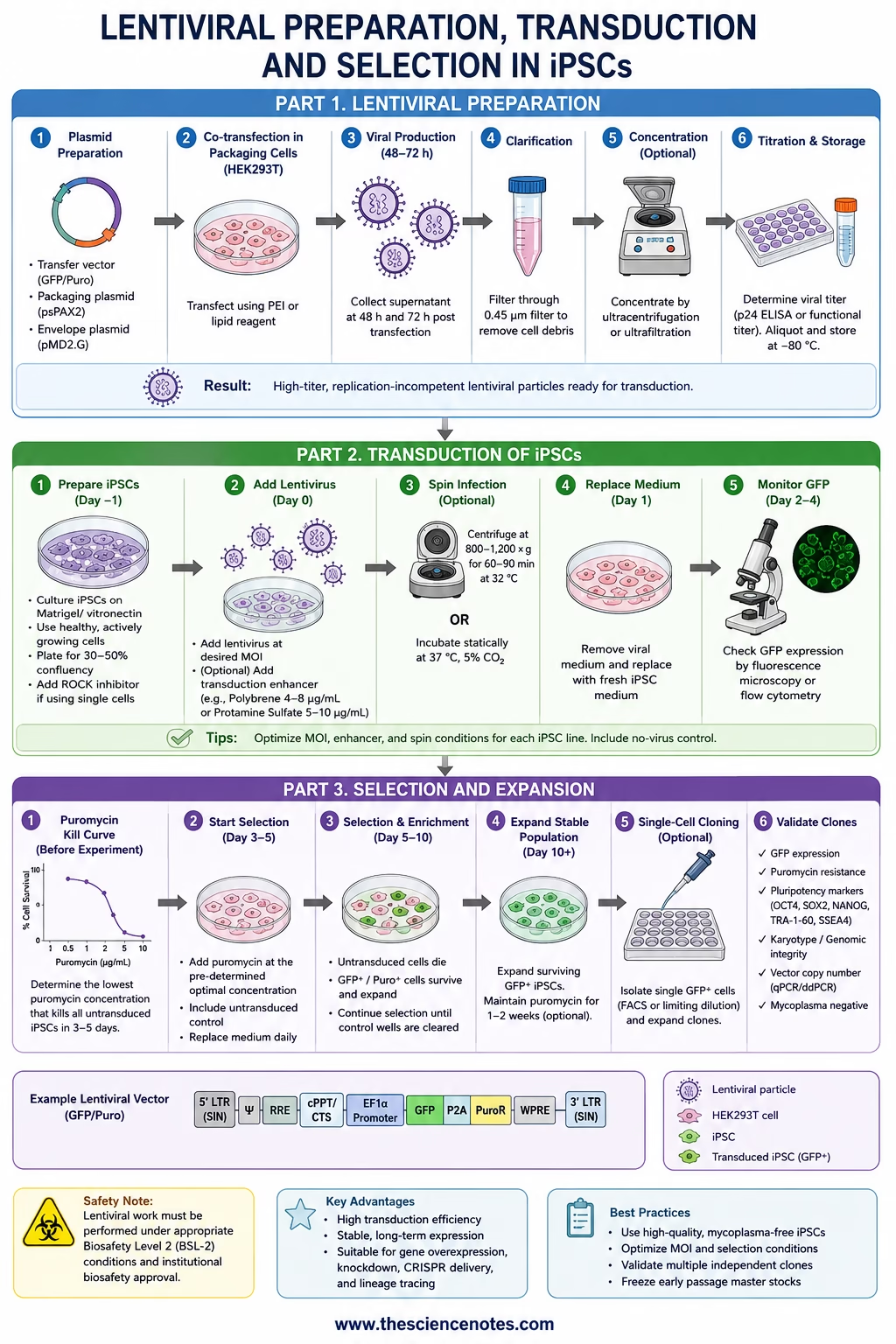
Lentiviral transduction is a extensively used technique for secure genetic modification of human induced pluripotent stem cells, or iPSCs. It’s generally used to introduce reporter genes, inducible transcription components, shRNAs, miRNAs, CRISPR elements, lineage-tracing programs, and selectable markers.
A typical design is a lentiviral vector carrying GFP and puromycin resistance, both as separate expression cassettes or linked by an IRES or 2A peptide. GFP permits early visible or flow-cytometric monitoring of transduction effectivity, whereas puromycin permits enrichment or secure collection of transduced cells.
This protocol describes a research-use workflow for iPSC lentiviral transduction with GFP/puro choice, together with tradition preparation, transduction optimization, elective spin an infection, puromycin kill curve, GFP-based evaluation, antibiotic choice, clonal isolation, and high quality management.
Scope and Biosafety
This protocol assumes that replication-incompetent, self-inactivating lentiviral particles have already been produced, concentrated if wanted, titered, launched to be used, and authorised underneath your institutional biosafety workflow.
Don’t carry out lentiviral work with out:
- Institutional biosafety approval
- Lentiviral coaching
- Licensed Class II biosafety cupboard
- Authorized PPE
- Validated disinfectant and get in touch with time
- Authorized lentiviral waste dealing with
- Sealed centrifuge carriers or sealed rotors if spin an infection is used
- Documented exposure-response process
Self-inactivating lentiviral programs are most popular for iPSC work, however SIN design doesn’t get rid of the necessity for biosafety controls or downstream genomic validation.
Overview of the Workflow
| Day | Step |
|---|---|
| Earlier than experiment | Affirm vector map, titer, GFP/puro design, and biosafety approval |
| Earlier than experiment | Carry out puromycin kill curve on parental iPSCs |
| Day −2 to −1 | Put together wholesome iPSCs and coated plates |
| Day −1 | Plate iPSCs for transduction |
| Day 0 | Add GFP/puro lentivirus ± enhancer ± spin an infection |
| Day 1 | Change virus-containing medium |
| Day 2–4 | Assess GFP expression and cell well being |
| Day 3–5 | Start puromycin choice after restoration |
| Day 5–14 | Proceed choice and broaden surviving GFP-positive inhabitants |
| Week 2–4 | Increase bulk inhabitants or isolate clones |
| Week 3+ | Validate GFP, puromycin resistance, pluripotency, genomic integrity, and vector copy quantity |
Supplies
Cells and tradition reagents
- Human iPSC line, mycoplasma-negative
- Validated iPSC upkeep medium, resembling mTeSR, Important 8, StemFlex, or lab-standard medium
- Validated matrix, resembling Matrigel, vitronectin, laminin-521, or lab-standard substrate
- ROCK inhibitor, generally used throughout single-cell plating or stress restoration
- Light dissociation reagent, resembling EDTA-based reagent or Accutase, relying on the road
- DPBS or equal wash buffer
- Commonplace iPSC freezing medium
Lentiviral reagents
- Titered self-inactivating GFP/puro lentiviral inventory
- Elective transduction enhancer:
- Protamine sulfate
- Polybrene
- Poloxamer-based enhancer
- LentiBOOST-type reagent
- Puromycin inventory answer
- No-virus management
- Enhancer-only management
- Constructive-control GFP lentivirus, if obtainable
Assay reagents
- Movement cytometry buffer
- DAPI, PI, or different viability dye if circulate cytometry is used
- Antibodies for pluripotency markers:
- OCT4
- SOX2
- NANOG
- TRA-1-60
- SSEA4
- qPCR or ddPCR reagents for vector copy quantity
- Mycoplasma take a look at package
- Karyotype, SNP array, or equal genomic integrity assay
Experimental Design
Don’t run a single-condition transduction as the primary try. iPSC strains differ in survival, transduction effectivity, promoter silencing, puromycin sensitivity, and clonal restoration.
Beneficial pilot matrix:
| Situation | Virus | Enhancer | Spin an infection | Function |
| Untransduced | No | No | No | Baseline morphology |
| Puromycin-control parental cells | No | No | No | Confirms kill curve |
| Enhancer-only | No | Sure | No | Enhancer toxicity |
| Low-virus static | Low | Elective | No | Low-copy candidate |
| Medium-virus static | Medium | Elective | No | Foremost situation |
| Excessive-virus static | Excessive | Elective | No | Most expression comparability |
| Low/medium-virus spin | Low or medium | Elective | Sure | Exams spin profit |
| Excessive-virus spin | Excessive | Elective | Sure | Excessive-efficiency however higher-stress comparability |
The very best situation isn’t essentially the one with the brightest GFP. The very best situation is the one with acceptable GFP positivity, good viability, preserved iPSC morphology, manageable vector copy quantity, and good downstream differentiation efficiency.
Puromycin Kill Curve
Carry out a kill curve earlier than utilizing puromycin choice. Don’t copy puromycin doses from HEK293T cells, fibroblasts, or one other iPSC line.
Function
To establish the bottom puromycin focus that reliably kills untransduced parental iPSCs throughout the desired choice window.
Process
- Plate parental iPSCs in the identical format, medium, matrix, and density deliberate for transduction.
- Permit cells to connect and get well in a single day.
- Apply a puromycin focus sequence.
- Embody a no-puromycin management.
- Feed cells on the identical schedule deliberate for the precise experiment.
- Monitor each day for:
- Cell loss of life
- Detachment
- Surviving colonies
- Differentiation
- Morphologic stress
- Choose the bottom puromycin focus that eliminates all untransduced iPSCs throughout the supposed choice interval.
- Repeat the kill curve if the iPSC line, medium, matrix, passage technique, or tradition format modifications.
Sensible interpretation
- If all cells die too shortly, the dose could also be unnecessarily harsh.
- If parental cells survive too lengthy, the dose could also be too weak.
- For iPSCs, extreme antibiotic stress can choose for irregular or unusually resistant subpopulations, so use the minimal efficient dose.
Day −1: Plate iPSCs for Transduction
Aim
Plate iPSCs in order that they’re wholesome, hooked up, and sub-confluent on the day of transduction.
Process
- Coat tradition plates utilizing the validated matrix for the iPSC line.
- Put together iPSCs from a wholesome, low-differentiation tradition.
- Dissociate cells utilizing the lab’s normal technique:
- Small clumps for fragile strains
- Single cells for extra uniform lentiviral publicity
- Plate cells in full iPSC medium.
- Add ROCK inhibitor if utilizing single-cell plating or if the road is stress-sensitive.
- Incubate in a single day underneath normal iPSC tradition circumstances.
Goal state on Day 0
Cells ought to be:
- Connected
- Evenly distributed
- Actively proliferating
- Not over-confluent
- Low in spontaneous differentiation
- Wholesome by morphology
If cells are sparse, pressured, or differentiating on Day 0, delay transduction moderately than continuing with a compromised tradition.
Day 0: GFP/Puro Lentiviral Transduction
Static transduction process
- Examine cells by phase-contrast microscopy.
- Exclude wells with poor attachment, extreme differentiation, or uneven density.
- Thaw lentiviral aliquot in accordance with your institutional SOP.
- Put together virus-containing iPSC medium for every take a look at situation.
- Add transduction enhancer solely whether it is a part of the optimization matrix.
- Take away spent medium from iPSCs.
- Add virus-containing medium gently.
- Return cells to the incubator.
- File:
- iPSC line
- Passage quantity
- Matrix
- Medium
- Cell density
- Vector title
- Vector lot
- Purposeful titer
- Virus quantity or goal MOI
- Enhancer and focus
- Publicity period
- Operator
- Date
Elective spin an infection
Spin an infection shouldn’t be the default for iPSCs. Use it solely as a examined optimization situation and provided that allowed by your institutional lentiviral SOP.
Spin an infection might enhance virus-cell contact, however it will probably additionally improve stress, detachment, and differentiation. Embody a no-spin situation for comparability.
Consider spin an infection by evaluating:
- GFP-positive fraction
- Imply GFP depth
- Cell survival
- Detachment
- Differentiation
- Restoration after medium change
- Vector copy quantity
- Pluripotency marker retention
If spin an infection improves GFP however worsens survival or pluripotency, don’t use it for line era.
Day 1: Medium Substitute
- Take away virus-containing medium in accordance with authorised lentiviral waste procedures.
- Change with contemporary full iPSC medium.
- Proceed ROCK inhibitor briefly if cells have been single-cell plated or visibly pressured.
- Examine morphology and survival.
- File:
- Detachment
- Cell loss of life
- Colony morphology
- Differentiation
- Confluency
Keep away from harsh washing if the iPSC line detaches simply. If washing is required by your SOP, use the gentlest validated strategy.
Day 2–4: GFP Evaluation
GFP expression is often assessed after the vector has had time to specific. The precise timing is determined by promoter, vector design, and iPSC restoration.
Qualitative GFP verify
Use fluorescence microscopy to estimate:
- Whether or not GFP is detectable
- Whether or not expression is uniform or mosaic
- Whether or not GFP-positive cells retain iPSC morphology
- Whether or not vivid GFP correlates with cell stress
- Whether or not GFP is current in differentiated cells, undifferentiated colonies, or each
Quantitative GFP verify
Movement cytometry is beneficial if the consequence will decide choice technique.
Measure:
- Proportion GFP-positive cells
- Imply fluorescence depth
- Viability
- Scatter profile
- Elective pluripotency marker co-expression
Advised interpretation:
| Consequence | Which means | Motion |
| Low GFP, wholesome cells | Underneath-transduced | Improve virus, take a look at enhancer, or take a look at spin situation |
| Excessive GFP, excessive loss of life | Too harsh | Cut back virus, take away enhancer, keep away from spin |
| Excessive GFP, wholesome morphology | Candidate situation | Proceed to choice |
| GFP primarily in differentiated cells | Poor tradition high quality or marker bias | Enhance iPSC tradition earlier than repeating |
| Mosaic GFP | Anticipated after bulk transduction | Use choice or clonal isolation |
Day 3–5: Begin Puromycin Choice
Don’t begin puromycin instantly after transduction except the system has already been validated. Beginning too early can kill transduced cells earlier than puromycin resistance is sufficiently expressed.
When to start out
Start choice when:
- Cells have recovered from transduction
- GFP is detectable
- Colonies are hooked up and viable
- The deliberate kill-curve dose is out there
- No-virus choice management is included
Puromycin choice process
- Change medium with contemporary iPSC medium containing the kill-curve-defined puromycin focus.
- Apply the identical puromycin focus to the untransduced management.
- Feed each day or in accordance with puromycin stability and iPSC well being.
- Monitor morphology and loss of life each day.
- Proceed choice till the untransduced management is totally eradicated.
- Keep surviving transduced cells till they get well and broaden.
- Cut back, pulse, or discontinue puromycin provided that suitable with the vector design and experimental objective.
Choice endpoints
A profitable choice ought to produce:
- Clear loss of life of untransduced management cells
- Survival of transduced cells
- Enrichment of GFP-positive cells
- Retention of iPSC morphology
- Minimal spontaneous differentiation
If puromycin choice causes widespread loss of life even in GFP-positive wells, the dose could also be too excessive, choice might have began too early, or transgene expression could also be inadequate.
GFP-Primarily based Enrichment Versus Puromycin Choice
GFP and puromycin can be utilized individually or collectively.
GFP monitoring solely
Use when:
- You want early transduction readout
- You intend to isolate clones manually
- Antibiotic choice is simply too anxious
- The vector isn’t supposed for long-term antibiotic stress
Puromycin choice solely
Use when:
- GFP is absent or not dependable
- The marker is non-fluorescent
- Bulk enrichment is ample
GFP plus puromycin
Use when:
- You need early visible affirmation
- You want antibiotic enrichment
- You need to type or decide GFP-positive colonies
- You need to affirm that puromycin-resistant cells are additionally GFP-positive
FACS sorting for GFP
FACS can quickly enrich GFP-positive iPSCs, however it provides single-cell stress. If sorting is used:
- Use viability dye
- Use mild dissociation
- Kind into supportive medium
- Plate onto optimized matrix
- Use ROCK inhibitor
- Keep away from overly stringent gates if expression continues to be maturing
- Permit restoration earlier than additional choice or cloning
Bulk Growth After Puromycin Choice
Bulk GFP/puro-selected populations are helpful for pilot assays and a few screening workflows.
Process
- Proceed feeding chosen cells till surviving colonies broaden.
- Take away apparent differentiated areas manually if essential.
- Passage gently earlier than cultures change into over-confluent.
- Keep puromycin provided that wanted to protect the transduced inhabitants.
- Affirm GFP enrichment by microscopy or circulate cytometry.
- Freeze early-passage bulk shares.
Limitations of bulk populations
Bulk populations might comprise:
- A number of integration websites
- Variable copy numbers
- Totally different GFP intensities
- Differentiation-prone subpopulations
- Partially silenced cells
- Combined organic habits
For illness modeling, differentiation phenotyping, rescue research, or mechanistic experiments, clonal isolation is often preferable.
Clonal Isolation of GFP/Puro iPSCs
Clonal iPSC strains are beneficial when reproducibility, genotype, expression degree, or differentiation phenotype issues.
Timing
Start clonal isolation after:
- Cells survive puromycin choice
- GFP expression is detectable
- iPSC morphology is recovered
- Cultures should not over-stressed
Strategies
Widespread choices embrace:
- Limiting dilution
- Single-cell FACS sorting of GFP-positive cells
- Handbook selecting of GFP-positive colonies
- Semi-clonal low-density plating adopted by colony selecting
Clonal isolation process
- Put together matrix-coated plates.
- Put together supportive iPSC medium with ROCK inhibitor.
- Dissociate chosen GFP-positive cells gently.
- Plate at clonal density or type single GFP-positive cells.
- Keep away from disturbing plates throughout early colony formation.
- Feed gently.
- Establish rising colonies with good iPSC morphology.
- Affirm GFP expression by microscopy.
- Decide particular person colonies into separate wells.
- Increase steadily.
- Freeze early backup vials.
- Validate earlier than downstream use.
Clone choice standards
Prioritize clones that present:
- Regular iPSC morphology
- Secure GFP expression
- Puromycin resistance
- Strong growth
- Minimal differentiation
- Reasonable expression, if overexpression toxicity is feasible
- Acceptable vector copy quantity
- Regular genomic integrity
Keep away from clones that present irregular progress, extreme differentiation, unusually excessive GFP with poor morphology, or poor restoration after passaging.
Clone-Degree High quality Management
1. GFP and puromycin validation
Affirm:
- GFP-positive proportion
- Imply GFP depth
- GFP stability throughout passages
- Survival underneath puromycin
- Lack of parental cells in choice management
- No main GFP silencing after growth
2. Vector affirmation
Beneficial assays:
- PCR for vector-specific sequence
- qPCR or ddPCR for vector copy quantity
- RT-qPCR for transcript expression, if related
- Western blot or immunostaining for protein expression, if related
For a lot of iPSC purposes, moderate-copy clones are preferable to very high-copy clones.
3. Pluripotency testing
Validate:
- OCT4
- SOX2
- NANOG
- TRA-1-60
- SSEA4
- Regular compact colony morphology
Use immunostaining, circulate cytometry, RT-qPCR, or a mix relying on the lab’s normal QC workflow.
4. Genomic integrity
Beneficial:
- G-banded karyotype, SNP array, or equal assay
- Vector copy quantity
- Integration-site evaluation if the appliance requires it
- Off-target evaluation if CRISPR elements have been delivered
5. Purposeful validation
Earlier than utilizing clones in main experiments, affirm:
- Differentiation capability
- Lineage-specific marker expression
- Anticipated phenotype
- Stability of GFP by differentiation, if required
- No sudden progress or survival benefit
- Comparable habits to parental and mock-treated controls
Troubleshooting GFP/Puro iPSC Transduction
Drawback: GFP is low after transduction
Attainable causes:
- Low useful titer
- Poor promoter exercise in iPSCs
- Dense colonies
- Poor vector entry
- Brief publicity
- No enhancer
- Lentivirus misplaced exercise after freeze-thaw
Options:
- Use contemporary or higher-titer virus
- Take a look at a better virus situation
- Optimize plating density
- Examine single-cell versus clump plating
- Take a look at protamine sulfate or one other enhancer
- Take a look at spin an infection facet by facet
- Affirm promoter is lively in iPSCs
Drawback: GFP is excessive however cells die
Attainable causes:
- Extra viral load
- Enhancer toxicity
- Spin an infection stress
- Transgene toxicity
- Single-cell stress
- Poor beginning tradition
Options:
- Cut back virus dose
- Take away enhancer
- Keep away from spin an infection
- Use ROCK inhibitor help
- Delay choice
- Take a look at inducible or weaker promoter design
- Enhance iPSC tradition earlier than repeating
Drawback: Puromycin kills all cells
Attainable causes:
- Choice began too early
- Puromycin dose too excessive
- Resistance cassette not expressed properly
- Vector silencing
- Poor transduction effectivity
- Cells have been already pressured
Options:
- Delay choice till GFP is detectable and cells get well
- Repeat kill curve
- Decrease puromycin focus
- Lengthen restoration interval
- Use GFP sorting as a substitute of antibiotic choice
- Display screen vector design
Drawback: Puromycin choice leaves GFP-negative cells
Attainable causes:
- Separate cassette habits
- Low GFP expression threshold
- Promoter silencing of GFP however not puro
- Autofluorescence misinterpretation
- Combined inhabitants
Options:
- Affirm by circulate cytometry
- Re-sort GFP-positive cells
- Isolate clones
- Validate vector sequence and expression cassette
- Affirm puromycin resistance is vector-derived
Drawback: GFP fades over passages
Attainable causes:
- Promoter silencing
- Lack of choice
- Clone-specific integration impact
- Differentiation-associated silencing
Options:
- Keep puromycin if acceptable
- Display screen further clones
- Use a extra secure promoter
- Take a look at expression after differentiation
- Keep away from counting on CMV promoter except validated in your system
Drawback: Clones differentiate after choice
Attainable causes:
- Overly harsh puromycin choice
- Spin an infection stress
- Single-cell stress
- Poor matrix or medium
- Selecting poor-quality colonies
Options:
- Cut back choice stress
- Enhance restoration circumstances
- Use ROCK inhibitor throughout cloning
- Decide solely high-quality colonies
- Keep away from over-confluence
- Repeat from more healthy beginning iPSCs
Finest Practices for GFP/Puro iPSC Lentiviral Transduction
- All the time carry out a puromycin kill curve.
- Use GFP to evaluate timing earlier than beginning choice.
- Don’t begin puromycin instantly except validated.
- Embody untransduced puromycin-control wells.
- Optimize virus dose moderately than maximizing it.
- Deal with spin an infection as elective, not routine.
- Affirm that GFP-positive cells retain iPSC morphology.
- Increase a number of unbiased clones.
- Measure vector copy quantity when interpretation issues.
- Validate pluripotency and genomic integrity earlier than differentiation research.
- Freeze early-passage shares.
Conclusion
GFP/puro lentiviral transduction is a sensible and highly effective technique for producing secure genetically modified iPSC strains. GFP gives a real-time readout of transduction effectivity, whereas puromycin permits enrichment of transduced cells. Nevertheless, profitable iPSC lentiviral transduction requires greater than GFP positivity and antibiotic survival.
The ultimate objective is a wholesome, genomically secure, pluripotent iPSC inhabitants or clone with reproducible expression and dependable differentiation efficiency. For that purpose, each GFP/puro workflow ought to embrace a virus-dose optimization, puromycin kill curve, cautious timing of choice, elective however managed spin an infection testing, clonal validation when wanted, and rigorous QC earlier than downstream experiments.
